








 Fabian
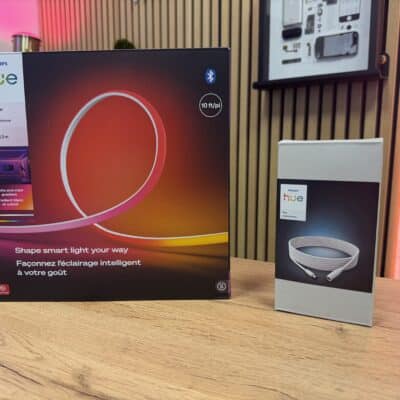
A few weeks ago, I didn’t think twice about ordering a Philips Hue OmniGlow light strip at my own expense. Not 3 metres, not 5 metres. In the end, I got 10 metres for €349.99. And I had no idea where to put this long and, above all, expensive light strip.
At first, I considered running it across the ceiling throughout the entire ground floor. However, 10 metres wouldn’t have been quite enough, and unfortunately, the light strip cannot be extended afterwards – unlike the Hue Flux, for example.
But the Hue OmniGlow Lightstrip has a completely different advantage: individual light points are no longer visible on the LED strip. Philips Hue even does a much better job than Govee, for example, as I discovered in a direct comparison. You can find all the important technical details in the linked article.
This is how the Hue OmniGlow light strip ended up on my staircase
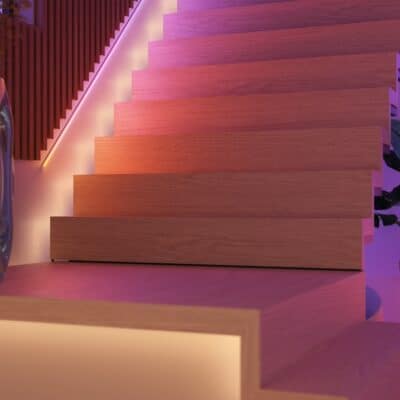
Thanks to its excellent technology, the light strip does not need to be hidden away, but can be placed visibly on the wall or ceiling. And since my wife had been wanting a proper night light on the staircase from the first to the second floor for quite some time, I simply installed the Hue OmniGlow throughout the entire stairwell.

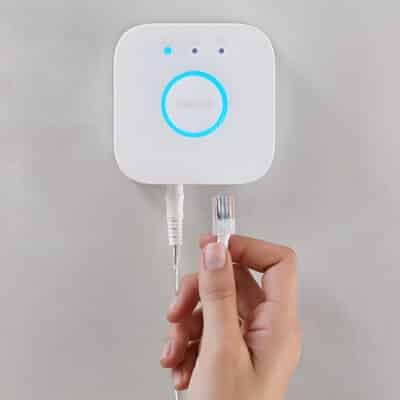
Let’s start at the bottom on the ground floor. Here, I have a small cupboard in the corner under the stairs, which houses the router, among other things. It’s the perfect starting point for hiding the controller and power supply. The small distance between the controller and the start of the light strip can be a real problem here.
To be honest, I started at the end because I wanted to achieve a clean finish on the ceiling. The Hue OmniGlow light strip can be cut every 12.5 centimetres; the markings are only visible on the underside of the light strip.
Two problems complicate the installation
As I was hanging up there on the ladder under the ceiling, I noticed two problems with installing the Hue OmniGlow light strip. First of all, the double-sided adhesive tape on the light strip itself is unfortunately not particularly strong. At least not strong enough to permanently mount the light strip directly under the ceiling. I had to use Tesa Powerbond in some places to prevent the light strip from falling off after just a few minutes.
The other problem was quite annoying: the protective film on the adhesive strip is interrupted every 20 centimetres. With a total of 8.75 metres to install, I had to peel off 44 strips. That really doesn’t feel like a premium product. In any case, I would welcome it if Philips Hue opted for a continuous protective film that is perforated in some places for easy removal.

The result is simply magical
Unfortunately, Philips Hue does not yet offer effects such as running lights, but I still find the result sensational. The night light set to 1 per cent is wonderfully subtle for use at night. In the evenings, we use the long Hue OmniGlow for a touch of warm light that is evenly distributed over two floors. And when we have guests visiting or the kids want something colourful, the Hue OmniGlow conjures up a colourful gradient from the bottom to the top.

And when you see the result, £349.99 might not seem like such a lot after all. In any case, it would have been much more complicated to conjure up some kind of light on the second floor. Because apart from the wall lighting there (my wife really wanted a retro wall light), there are no sockets or connections to be found. That would have been a major undertaking.
What I hope to show you with this is that the Hue OmniGlow Lightstrip is ideal for visible installation. The lighting result is absolutely impressive, especially in combination with other Hue lights. Philips Hue just needs to make a few improvements to the adhesive strip.
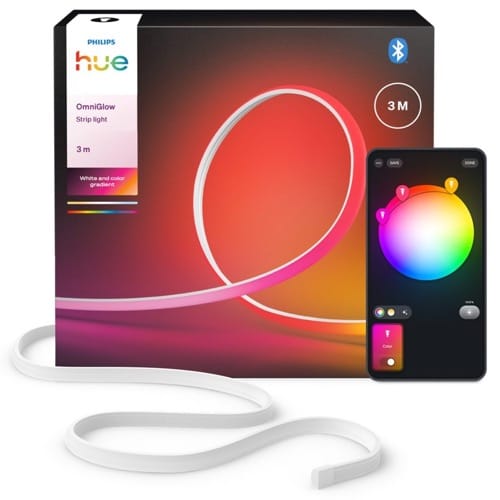
Hue OmniGlow Gradient Lightstrip
from $139.99 / €139.99

We light-up our spouse’s lives❣️
Still only the 3M available in US. Do odd.
Did you purchase abroad and do you live in the US? Was it easy to convert to US electrical standards?