






 Fabian
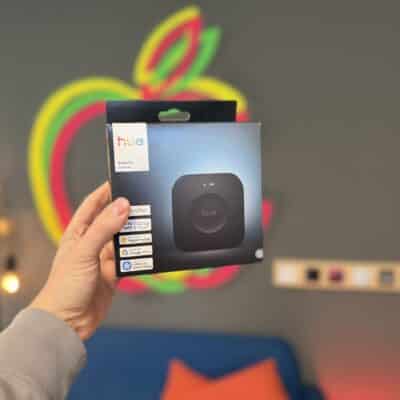
I have now been able to give you a closer look at almost all of the new light strips that Philips Hue introduced last year. Apart from the Flux Outdoor Lightstrip, the only one missing is the Hue Essential Flex, which I have only seen at the Hue event in Berlin so far. I have now had the opportunity to unpack it myself and would like to share my first impressions with you today.
Philips Hue will launch two models of the Hue Essential Flex. You can choose between 5 metres for €99.99 and 10 metres for €169.99. According to my latest information, it should be available at the beginning of February. However, depending on the country and region, it may take a little longer.
The first light strip of its kind from Philips Hue
Apart from the new premium model, the Hue OmniGlow, previous Philips Hue light strips for indoor use were designed for concealed installation. This is definitely not the case with the Hue Essential Flex. It is intended to be visibly mounted on the wall, preferably in a stylish design.

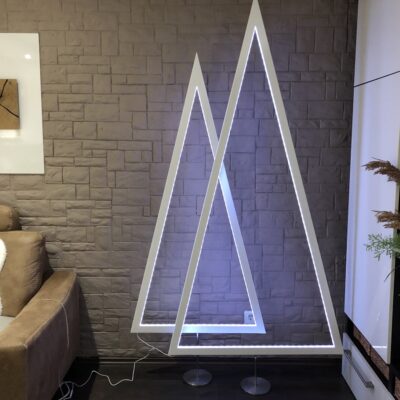
Unlike the normal Philips Hue light strips, the Hue Essential Flex can be bent to the left and right. Together with 25 (50 for the 10-metre strip) small brackets for screwing or gluing, you should be able to conjure up stylish shapes on the wall. I still need to think about how I can best showcase the light strip in my home. Perhaps you already have a suitable idea for your wall or ceiling?
Good to know in this regard: the 10-metre-long Hue Essential Flex is divided into two 5-metre-long pieces. These are connected behind the Zigbee controller with a Y-cable. Although the 10-metre Hue Essential Flex is divided into two parts, it is recognised as a single light strip by the Hue app. However, the display is not distributed across the two light strips; instead, both show the same colour gradient. For this reason, the 5-metre version is my favourite.

Hue Essential Flex delivers not bright lighting, but mood lighting
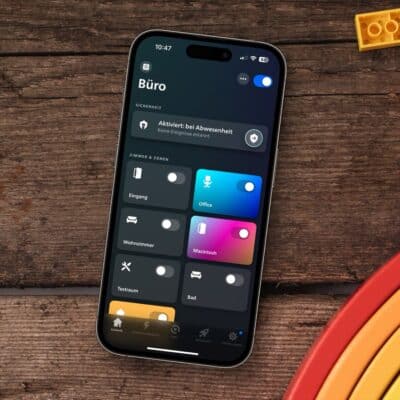
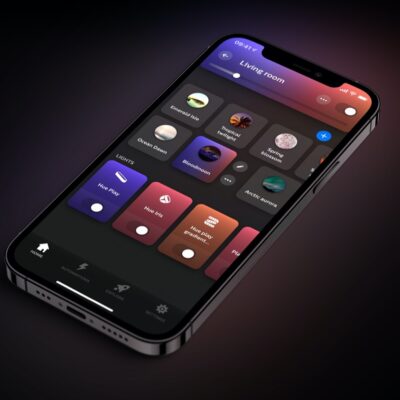
Of course, the Hue Essential Flex light strip features gradient technology, so it can display colour gradients. Philips Hue now also offers the new ‘Segmented’ mode, which allows multiple colours to be displayed without a gradient.
However, the affordable Hue Essential series does not use cool white and warm white LEDs; this light strip only features pure RGB technology. This means that white light can also be mixed, which in principle does not look too bad, but it lacks the brightness we are used to. The Hue Essential Flex is therefore definitely intended for decorative purposes.


The light strip, which is approximately 0.6 centimetres wide and 1.4 centimetres high, cannot be shortened. The colour rendering is uniform, but slight shadows are visible. The LED spacing could therefore have been a little more compact. As always, the colour rendering itself is excellent, with the Hue Essential Flex only reaching its limits with dark purple tones.
While I really only see the price as an argument in favour of the simple Hue Essential Lightstrip, which is likely to be a challenge due to the many discount promotions surrounding the Hue Flux light strip, I am much more positive about the Hue Essential Flex. This light strip closes a gap in the Philips Hue portfolio.
A look at the competition
Until now, you had to turn to the competition for a light strip of this type. Of course, Govee already has the right product on the market, namely the Govee Neon Rope Light 2. It even comes in three different lengths: 3, 5 and 10 metres. With a recommended retail price of €99.99 and €179.99 for the two longer versions, it is in some cases even more expensive than Philips Hue. However, there are already discounts of 30 to 40 per cent available in stores.
I took a look at the Govee product some time ago. From a technical point of view, it is definitely on par, but the software was and still is a very creepy story. So it’s all the more gratifying that we will soon have a comparable product from Philips Hue in the form of the Hue Essential Flex. As soon as it’s available, I’ll get back to you – and until then, I’ll be thinking about how I can show off the light strip to its best advantage.

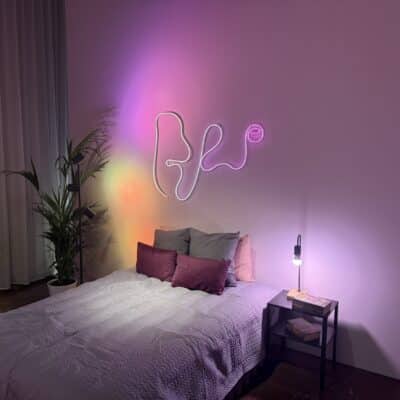
I just got this product. It’s ok. But the LEDs are definitely visible. Meaning it does not look that uniform. Wish the LEDs were more compact.
I don’t have the Govee Neon Rope Light to compare.