





 Fabian
Yesterday I was a guest at Logitech in Munich. You’re probably wondering: What does this have to do with Philips Hue? Well, the two companies have launched a partnership. For some time now, you’ve been able to control Hue lights using the Logi Options+ software in conjunction with MX products. But that’s another story, which I’ll explain in more detail to you soon.
While talking with the lovely folks at Philips Hue, I was asked again which product I thought was still missing from their portfolio. Among other things, a presence sensor came to mind—like the ones already available from manufacturers such as Aqara or Meross.
Here are the current options
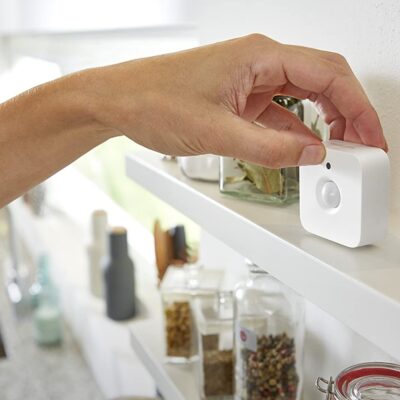
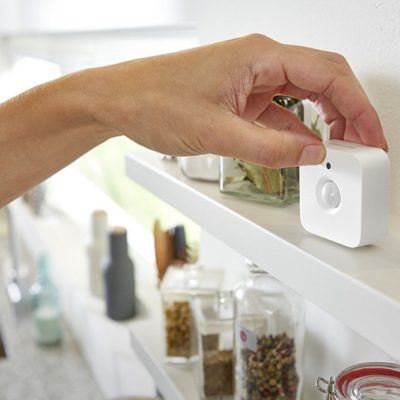
Currently, Philips Hue offers the well-known motion sensor, which is actually celebrating its tenth anniversary this September. It works with a passive infrared sensor that detects changes in heat within its field of view and then triggers the lights. The problem with this is that dogs and cats can also trigger the sensor. And if you don’t move enough, you’re invisible to the sensor.
As a second alternative, at least for the Hue Bridge Pro, there’s the new MotionAware feature. Here, using three or four Hue lights and radio signals, the system detects whether someone is moving between these lights. But even here, a simple, quiet presence cannot be detected, and the technology can’t be used in some rooms at all—for example, if only a ceiling light is in use.

These are the advantages of presence sensors
Unlike traditional PIR-based motion detectors, a presence sensor detects not only large movements but also very subtle changes in the room. As a result, the light stays on, for example, even when someone is sitting quietly at a desk, reading, or working. While a PIR sensor, as mentioned, primarily reacts to heat movements and quickly “stops detecting anything” during prolonged inactivity, modern presence sensors monitor the room much more precisely and continuously.
Many modern presence sensors use high-frequency or mmWave technology (millimeter-wave radar). This technology can detect even minimal movements, such as breathing or hand movements, and often works regardless of temperature differences or direct line of sight.
Are you interested in a Philips Hue presence sensor?
Personally, I’m convinced that upgrading the Philips Hue motion sensor to mmWave technology would be a really great idea. However, I haven’t heard any rumors in that direction yet. Maybe we can get the manufacturer to consider it together—feel free to leave a comment below and let us know if a Philips Hue presence sensor like this would be of interest to you…


Yes, yes, yes, yes!!!
Yes!
Yes yes yes! I’m trying to be patient and not jump into Home Assistant + Aqara as the entire point of been in Philips Hue was to have a simple and reliable ecosystem with one provider. I don’t mind to pay the “Hue tax” if they offer me a reliable and simple to manage ecosystem with high quality products. A presence sensor is the only fundamental piece that the ecosystem is missing and we have been waiting for too long. It’s 2026 and many manufacturers have presence sensors available. It’s annoying to be sitting drinking my coffee in the kitchen and need to keep moving my arms to avoid the lights to switch off.
Personally, If I end up been forced to add Home assistant and Aqara then I’ll not be paying the Hue tax anymore and I’ll introduce more providers in my setup (if I need to manage a more complex setup then I will at least benefit from saving some money on cheaper light options, sensors and switches that are comparable in quality)
Absolutely agree with everything you said there!! I find myself having to flap around too.
Yes, I think if you look at how well the aquara sensor works for presenters detection and visibility in the app, it is a logical addition to the hue lineup…
I have often the problem that when you sit on the dinner table or sofa the motion sensor no longer sees you are there due to lack of movement & to combat this I set very long turn off times in the automation.
My only concern is that the cost from Philips would be prohibitive.
The simple motion sensor is 4x the price of the equivalent IKEA.
presence sensors are not cheap so to multiply this by 3 or 4 for a hue version is probably why they won’t do it.
I’ll guess that commercially it will make sense to not inflate the price of this particular product beyond what is reasonable for the average Hue target consumer. Having this as a low margin product will defend their margins in the rest of the ecosystem. If they don’t add it, people like me will jump into the Home Assistant bandwagon and then they will have substantially less chances of charging me the Hue tax.
Not really, just a home or away feature that turns on mimic presence. I don’t want Hue security lights, just for it to tell from my phone if I am home or not and act accordingly.
Sì, è arrivato il momento che Hue progetti il suo sensore di presenza, per farlo uscire il prossimo anno magari. Forza!
I recently tried out the new motion sensors in my front room and it works but three lights them just stay on. I can’t figure out a way to automate them to shut off a few minutes later. I searched online and then asked the in app Al which will see a time for them to go off after a few minutes but that is just for that one occasion. Does anyone know how to do this?
God yes. Im so annoyed that I have to use a Aqara presence sensor through matter and apple home to control my hue lamps with next to no smarts included.
Yes!
Yes!
Yep, be nice if it was battery to, but that might not be possible
Yes. I would buy one of these for every room in my home.
I’m surprised that they don’t have one already. A freestanding sensor and a wall plate/switch combo would sell well because they would be really useful.
Yes it does but will probably be a lot more than the current motion sensors. Signify still haven’t fixed the bug with “Do not disturb” still not working!!
They should also fix the “do not disturb” mode where the lights which are on are not supposed to be changed by the movement. It doesn’t work at all and it is extremely frustrating. You have movie lights set up for the living room and somebody goes to the toilet and all the lights turn to full blast. Really annoying.