







 Fabian
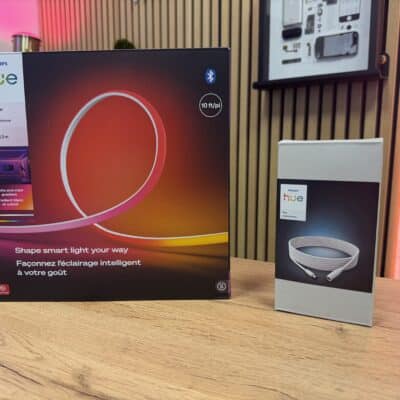
Philips Hue launched a bunch of new light strips this fall – at least in Europe. One of them is the Hue Flux, which comes in two different versions. In addition to the “normal” Flux light strip in five different lengths from 3 to 10 meters, there is also the particularly bright Hue Flux Ultra Bright Lightstrip. It is available in three different lengths, produces up to 6,000 lumens, and is also equipped with a gradient function.
But where to put all these light strips? Of course, you can also use the Hue Flux Lightstrip for larger projects, hanging it from your ceiling to create atmospheric indirect lighting for the entire room. Today, I would like to show you a slightly simpler option for adding a light strip to a cabinet or shelf using simple means.
Don’t let the light strip shine directly towards the wall
There are two obvious options, but both have major disadvantages. If you simply stick the light strip onto the cabinet, it looks modest. If, on the other hand, you stick it behind the cabinet, it shines directly towards the wall. This means that much of the lighting effect is lost.

My trick: Stick or screw something to the back of the cabinet or shelf that creates a 90-degree angle. A plastic cable channel is particularly inexpensive and easy to use. I found one-meter-long plastic T-profiles at the hardware store, which I then attached to the back of the cabinet with double-sided tape. I recorded the whole process for you in a short video. It is recorded in German, but you can activate English dubbing on YouTube:
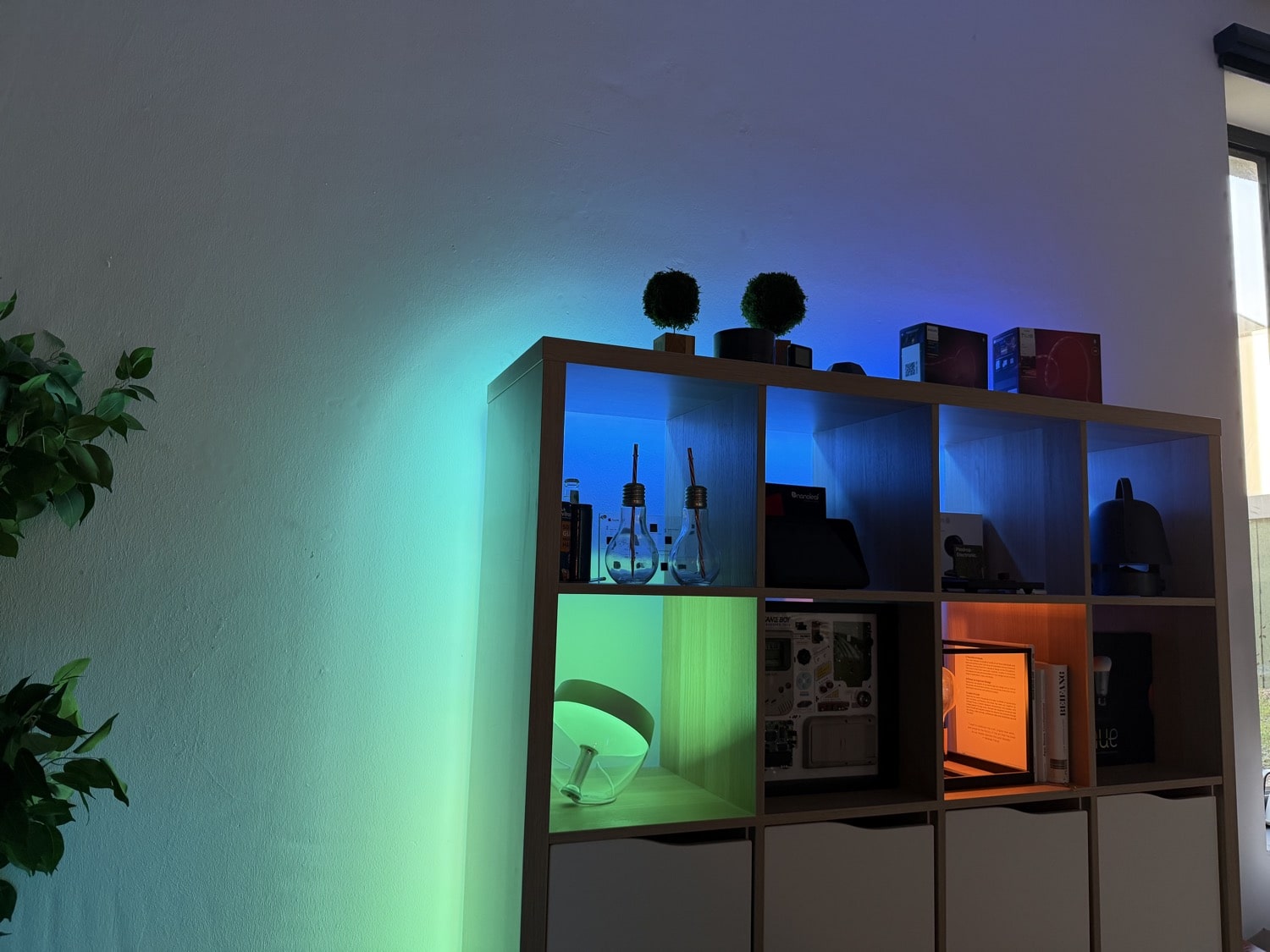
The T-profile has a decisive advantage: the light strip can be guided around corners more easily and no longer shines directly towards the wall, but upwards or to the side. This significantly increases the lighting effect on the wall.
During installation, I noticed that the underside of the T-profile and the open compartments of the Ikea Kallax shelf are ideal for attaching another light strip. While the Hue Flux Ultra Bright Lightstrip was installed at the top, I used a simple Hue Solo Lightstrip for the lower part of the lighting. It can’t display color gradients, but that didn’t bother me at this point.
I think the result is really successful. Maybe this little trick will help you with one of your next light strip projects. In any case, the Hue Flux is a suitable candidate.
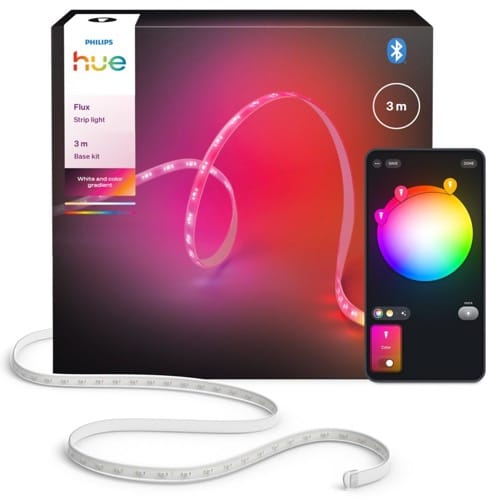
Hue Flux Gradient Lightstrip
from €69.99 / $69.99